Burzum, "Dunkelheit"

I think we all have (at least) a little something in us that is drawn to the Darkness. A certain fascination with the macabre. For the vast majority of us in civilized society, it’s a bystander’s fascination, a willingness—an enthusiasm, even—to consider humankind’s capacity to engage in the worst forms of cruelty and depravity, if never to engage in it ourselves. And of course there are the others, the very small minority, who actually roll up their sleeves and get after it. We don’t love the serial killers, the necrophiliacs, the black market organ traffickers. But I’d venture to say the social order requires a certain critical mass of them to be operating in the margins of society, so the rest of us can access the resulting lurid stories and images, in so doing quench our innate thirst for blood, and securely return to peaceable day-to-day living.
Did I just argue that society benefits from serial killers, necrophiliacs, and organ traffickers? That just as we want and need Colonel Jessup on that wall to defend the Free World, we also want and need one or more Ted Bundys in the wind, or at least relating their histories in jail, to rescue us from our worst animal instincts? Maybe don’t put those exact words in my mouth. I think it’s more accurate to say that humanity being what it is, there will always be Bundys, and Dahlmers, too. Taking this as a given, we would do well to make their crimes and pathologies broadly known to the community, rather than conceal them from the public record—first and foremost so that we can prevent like tragedies in the future.
But it’s important, too, for us all to understand what we do and don’t have in common with the psychopaths among us, the absolute monsters with whom we share 99.9% of our DNA yet have predilections and practices that are unimaginable for all of us who have the capacity for empathy and live on the right side of the law. One way to do achieve that understanding is to peer voyeuristically over the red line, to feel that actually-electric current surge up your spine when you acquaint yourself with the worst kind of manborne atrocity. Often enough we do this in the safety of our own homes: fast-forwarding to the part where Hannibal Lecter springs into action on his prison guards, for example, or lapping up all the grisly deets in Elizabeth Báthory’s Wikipedia entry.1 These experiences have common essential characteristics:
First, we take a perverse pleasure in the gruesome details.
Second, we feel emotionally conflicted: attracted and repelled, gratified and guilty.
Third, by indulging the Darkness, we get the better of it. We beat it back down inside us and step back into the light.
This is the work horror movies do. And true crime podcasts, Jack the Ripper tours, and documentary productions about Vlad the Impaler. We’ve built a scaffolding of social norms around these experiences, to ensure both that we have continued access to them and that we take care not to seem to enjoy them too much. Folklore of all kinds—from the original sin doctrine to Lady MacBeth, Jekyll/ Hyde, and Dorian Grey to Lord of the Flies and Breaking Bad—teaches that we card-carrying members of Homo supposedly sapiens are all of us perennially on a knife’s edge, and all it takes to turn any one of us into a murderous predator is a saturation of bad influences. We should take care, then, not to get too deep into these blood-and-guts stories—or at least come up for air and a reality check now and again.
All this is self-exculpatory prelude to what I want to talk about today, which is my on-again/ off-again fascination with Norwegian black metal.
I don’t recall under what specific circumstances I first heard about the Oslo-based rock band called Mayhem. I only remember that point in medias res where I found myself at my desk at work, breathlessly reading the Mayhem Wikipedia page. And jumping off from there into the many and various online sources documenting the unqualifiedly insane world of Norwegian black metal.
During the course of this essential research, it occurred to me that passers-by had a sightline on my computer display, so I got up and closed the door. This was a smart move, because soon enough my Google searches turned up the photograph Mayhem’s guitarist, Euronymous, took of his lead vocalist’s exploded head shortly after Dead—this was the singer’s name, Dead—died by suicide in the band’s woodland rehearsal space outside Oslo. This was in 1991, i.e., before cell phones, so upon finding his work colleague (and possibly his friend) Dead dead, Euronymous’s first instinct was to hitchhike into town to buy a disposable camera, then ride back to the scene to capture this ghastly tableau for posterity. The resulting photo went into wide circulation after a fan got hold of it and used it as cover art for a bootleg Mayhem live show.
There’s more to this story than I need, or am willing, to recount here. The point is, this was a workday just like any other for me, except that suddenly and unaccountably I’d gone down a Norwegian black metal hellhole and spent an hour or more gleefully freaking myself out. When I regathered my faculties, I deleted my browser history—again: this was my work computer—and took the elevator down to ground level for lunch. Needless to say, I didn’t eat very much.
The death of Dead wasn’t the end of the Mayhem story. Not by a long shot. A year later a miscreant named Varg Vikernes turned up in Oslo and joined Mayhem as its bassist. By this time the black metal musicians in Oslo were pushing one another to ever greater extremes—and not just in their objectionable lyrical themes, aggro backing music, creepy costuming (corpse paint was a thing), wild stage names (e.g., Hellhammer, Necrobutcher), and theatrical performance gestures (often involving animal parts). They seemed also to be bidding to out-criminal one another.
Now a race to the extreme bottom like this one is the natural cross-product of insularity and competition. We see it more and more these days in our political process. State legislatures gerrymander congressional districts largely exclusive to one party, and in the ensuing primary election each of that party’s candidates strives to prove that they’re the bigger partisan whack-job. For its part, Norway’s black metal scene was masterfully configured to drive its members to the worst extremes of antisocial behavior. For starters, this was a matter of national pride: the Norwegians were honor-bound to prove they were harder-core than the death metal clowns to their immediate south in Sweden.
Second, the black metal subculture was founded on principles of militant rejectionism and the desire to shock. We tend to associate these aspects with punk rock rather than metal. Consider the Sex Pistols’ infamous interview with Bill Grundy (see “Helter Skelter”), their flirtation with the swastika, and so on. By contrast, metal fans are often content to cast themselves as outsiders disdainful of the mainstream but never directly at war with it. And at least in America, metal and punk keep to their respective silos: no one is asking for them to cross-breed, so they don’t. Whereas the black metal horde in Oslo was most definitely punk-informed, which opened the door to a hyper-combustible chimeric combination of punk’s lash-out principles with gruesome Satanic metal themes.
Finally, the group was by design exclusive and hierarchical. The epicenter of Norwegian black metal was Euronymous’s Helvete (translates to Hell, of course) record shop. Euronymous promoted an “Inner Circle” within the scene, to be populated with only its most committed and extreme adherents. Aaaaaaand Euronymous was in the practice of making necklaces with—so he claimed—recovered shards of Dead’s skull, which he then awarded them to fellow musicians based on his sense of their value as black metalers. Sort of a grisly combination of merit badge, holy relic, and Mardi Gras beads. The question isn’t what would you do for a Dead’s Head necklace?—it’s what WOULDN’T you do?
Exclusivity fans the flames of competition, and we see that dynamic at work here, as members of Oslo’s black metal gang fanned out across Norway setting fire to churches. Between 1992 and 1996 more than twenty churches went up in smoke, amid more than fifty arson attempts. There were assaults, too, and at least one random killing, after a luckless middle-aged man propositioned Emperor’s drummer Faust in Lillehammer. Faust later coldly clarified that his deadly stabbing attack in a public park wasn’t a hate crime per se: I was out there, just waiting to make an assault, he said. It was supposed to happen, and if it was this guy or someone else, it wouldn’t change the outcome much.
Hierarchy leads to infighting, and we had that, too, here, in spades. Seems like folks were wondering why Euronymous was—or appeared to be—in charge. You see a bit of this in the lookback quotes from musicians formerly on the scene, questioning to what extent this dude was a poser. You see a lot more of it in the incident of August 10, 1993, when the aforementioned Mayhem bassist Varg Vikernes drove to Euronymous’s apartment from Bergen, stabbed him 23 times, and left him for dead. Vikernes claims self-defense. Even if we accept that to be true (23 stabs in self-defense?), the homicide was evidence enough of some real conflict within the NBM scene.
When I gave earlier examples of the ways in which we use culture and content as a safety-valve for gratifying our baser impulses—the Ripper tours, etc.—I left out metal. I was saving it for this paragraph. Metal is a five-decade (and counting) worldwide cross-generational cultural phenomenon that has generated easily tens of billions of dollars of wealth marketing macabre fantasies to a species that can’t quit the Darkness. As an industry, metal offers a range of subgenres and intensity levels to meet the specific needs of the individual audience member.
Like the Ripper tours, metal is storytelling, except with musicians standing in as the fabulists, in place of striving English actors. Metal acts shock and spook and thrill us with their fantastic rocked-up tales of blood and guts and Darkness. What the musicians don’t do is go out and engage in the dark deeds they’re describing. They may perform some kayfabe occult rituals on-stage, sure, but nobody actually dies on the slab. We recall Ozzie eating the bat because it was an exceptional case, and he was eager to tell us afterward that he thought the bat was fake when he took the bite. The Norwegian black metal bands of the 1990s were distinctive and troubling because they crossed over from storytelling into action. The musicians occupied dual roles as bards and agents of the Darkness. And for sure the conflict of interest that inheres in telling stories about yourself drove them to ever greater extremes, in both roles: the need for content led to ever more dangerous and depraved stunts, which they would embellish even more in the telling. Put plainly: shit got real in Norway.
How did we end up here? Was this a case of scattered psychopaths finding a common interest and then a common cause? If so, there sure was a concentration of psychopaths in Oslo in the 1990s. These days you need the Internet’s worldwide reach to tap into your niche category of antisocial belonging. Could instead these have been ordinary kids, with the same latent capacity for extreme violence we all have in us through natual selection (hence our interest in these matters), who were led down a dark road by bad cultural influences? And what role was played here by unique social conditions in Norway, a stiff and morally traditional Christian society that just happened to have really permissive criminal laws? Faust was sentenced to just 14 years’ imprisonment and served only 9; for his murder and multiple arsons, Vikernes went down for only 16.
For that matter, could the actual Devil have had a hand in this?
The whys and hows of Norwegian black metal’s formation and metastasis certainly deserve consideration, given the lives lost and lasting damage done. But for now let’s leave these questions to the sociologists, so that (1) they can make absolutely sure youth culture never runs quite so amok again, while (2) the rest of us who are knee-deep in the what can wade out into even deeper and murkier waters. Michael Moynihan and Didrik Soderlind’s Lords of Chaos: The Bloody Rise of the Satanic Metal Underground (Amazon) is probably the definitive work on the subject, impressively researched with supporting oral history-type testimonials from the participants. The film adaptation could have been made in a pure documentary style, but alas, it was a docudrama, and a Culkin brother played Euronymous. I saw it in the theaters. It was fine—not great.
At this point you’re likely thinking, What about the music? Some time ago my good friend Glenn and I were driving back from a day trip to New York. We got to talking about the Norwegian black metal scene and how crazy it was. It occurred to one of us, almost as an afterthought, that we should take a minute to hear what NBM actually sounded like. Glenn was driving, so I cued up the music. I settled on Mayhem’s De Mysteriis Dom Sathanis LP (Apple Music, Spotify), the recording of which was most closely contemporaneous with Dead’s death and Euronymous’s killing. You’ll note the inverted crosses and batwings that bookend the band’s logo: scary-scary! We didn’t need more than a minute to decide this record was utterly unlistenable. Glenn has more of a tolerance for metal than I do, and even he called the question in a hurry.
Burzum is a different story altogether. This was and continues to be Vikernes’s solo project. He composed, arranged, and recorded four Burzum records through the early ’90s, until his extracurriculars got the better of him and landed himself in prison. Burzum is of course a Lord of the Rings reference. Rock dorks down through the years have obsessed over Tolkien, and NMB was not immune. In addition to Burzum, the scene included bands named Isengard and Gorgoroth. For that matter, around the time he turned criminal Vikernes was asking folks to call him Count Grishnackh. The Tolkien books notably do not assign the honorific of Count to the orc-captain Grishnákh. Varg gave himself that boost in status.
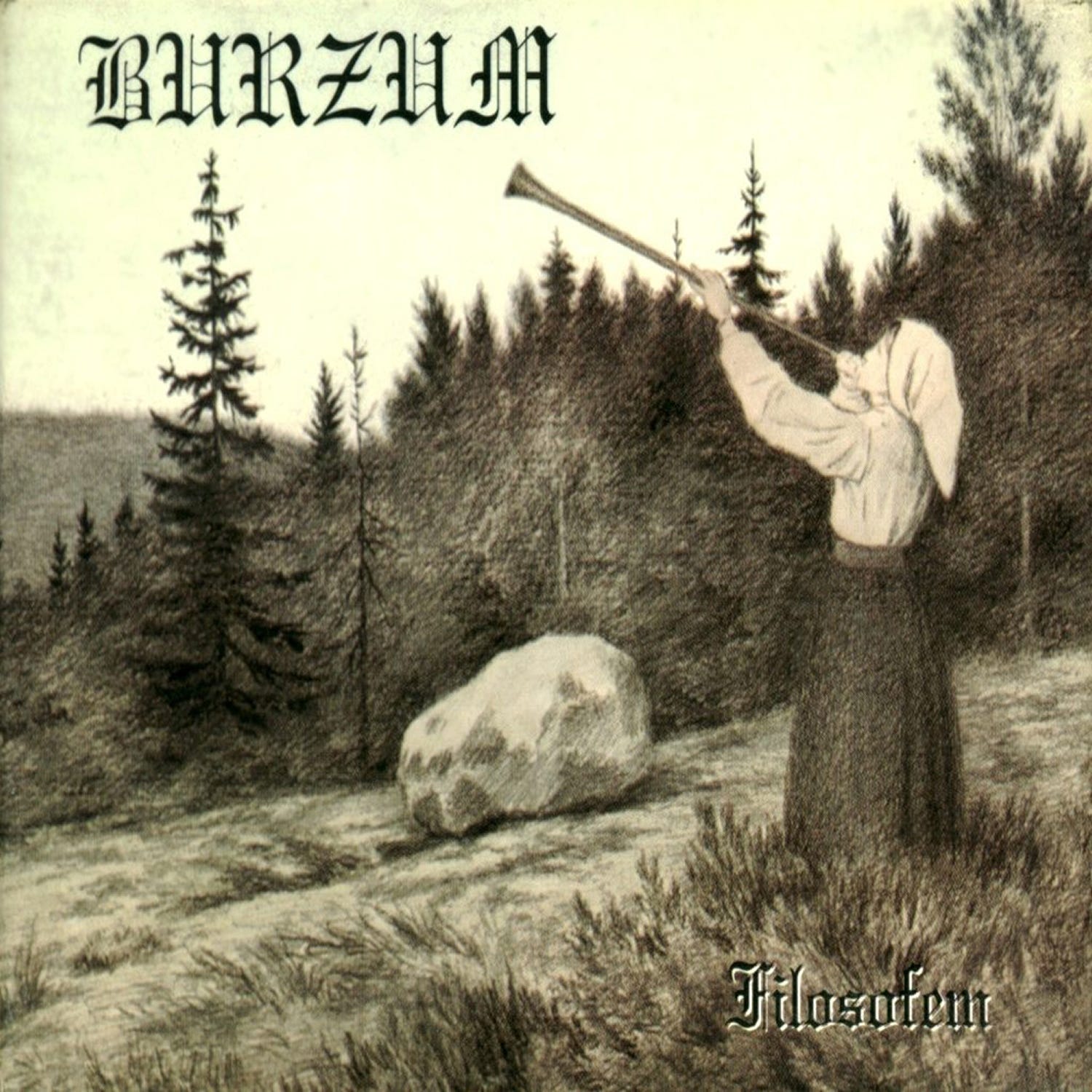
After I ran screaming from the Mayhem record—which I expect was exactly how the band would want a square like me to receive it—I looked into Burzum. The record I tried was 1995’s Filosofem. This was something different altogether: an experimental DIY production, played at a reasonable mid-tempo speed, rooted in principles of droning and repetition. Sort of like a metal Spacemen 3. What is more, there are electronics on this record, courtesy of a vintage analog synth Vikernes got hold of in the studio. And on the subject of available resources, Burzum recorded this record in the prestigious Bergen concert hall named for composer Edvard Grieg. Varg’s vocals are affected and distracting, but no more so than, say, Ian Curtis’s or Amy Winehouse’s. I can muddle through with them, given how interesting the music is.
Although this is probably a post best suited for Halloween week, I’m publishing it now because on July 4 I found and bought a copy of Filosofem on vinyl at Aux 33 Tours record store in Montreal. I’d been looking for it for a while. To be honest, I’m a little conflicted about owning this record. Like, I might have brought an evil talisman into my home … and I’m enough of a child of the 1980s that I haven’t fully banished the notion—pushed by unsophisticated and ridiculous people, I recognize (see “Let Beauty Loose”)—that rock ‘n’ roll can be actually dangerous. I can’t rule out that a saturation of listens to Filosofem will turn me to burning churches. Also, Vikernes remains, well, problematic. In prison he took up with Nazis, he has since developed and adopted a stupid ideology of pagan Scando-Aryan supremacy, and in 2014 he was charged and convicted in France of inciting racial hatred.
A while ago I staked out the position that an awareness of an artist’s background, history, and influences can enrich your experience of their music. This is the Krautrock journey I’ve been taking with Carla.2 Having said that, can I have it both ways? I.e., can I like some music because of who made it and other music in spite of them? The answer to that question has to be yes. Music is important enough to me that, if it’s good, I’m disinclined to let the objectionable politics or overall dirtbaggery of its maker put me off listening to it. Varg Vikernes has done a great many things that are contrary to law and my values. Making music isn’t one of those things.
But of course I’m protesting too much. My relationship to Burzum will always be complicated and discomfiting. I found my way here because—wow—this Norwegian black metal business is fascinating. It pokes and prods at my Darkness and scratches a particular, shameful itch. It’s not especially important to me that around the time Vikernes recorded Filosofem he was plotting arson and possibly murder. Maybe the music carries the imprint of a madman: I don’t think anyone can dispute that the sense of desperation that pervades Joy Division’s Closer flowed directly from Ian’s state of mind. But I don’t listen to a Burzum track like the aptly-named “Dunkelheit” (Apple Music, Spotify) to thrill over the fact that a killer wrote it, or that he was in thrall to the Darkness when he did. I listen to it because it’s good. And maybe I listen less than I otherwise might, out of a concern that whenever I drop the needle I give this man power—power I certainly don’t have, with the sub-100 read count I get for most of these posts.
At this point I’m talking in circles. Here’s the Take Take post on Norwegian black metal that nobody asked for or expected. The Darkness is in you. I suggest you give it ten minutes’ run every six weeks, then tamp it down, hug your loved ones, and go listen to the Sundays. (See “Can’t Be Sure.”)
Bathory is of course the name of a metal band.
Obligatory links: Apple Podcasts, Spotify.