Jesus Christ Superstar, "Everything's Alright"

It’s Easter weekend and still I’m not writing a post about my fave-ever song, “I Am the Resurrection” (Apple Music, Spotify). Linked time and time again, and never the subject of a post: the Stone Roses are starting to look like the Susan Lucci of this Substack.1
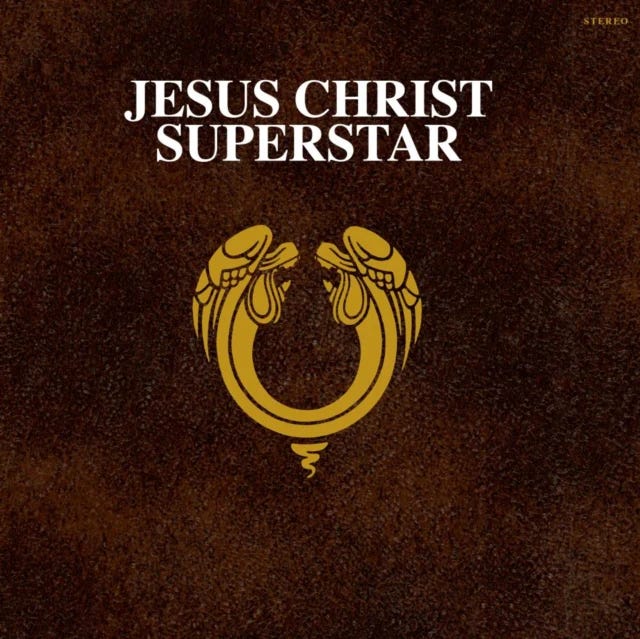
Around this time every year I cue up Jesus Christ Superstar (Apple Music, Spotify), the original “studio cast” recording from 1970. Now that I’m able to call the question for myself—Good Lord did my parents hear it from Tia and me on Sunday mornings, when they were rousting us out of our beds (“If God’s omniscient he can hear me praying at home,” and so on)—I’m not much of a churchgoer. And I’m not especially into musicals, either. So why do I love Jesus Christ Superstar so much? Sixty-plus posts into this project, you should know the Occam’s Razor answer: because it RAWKS.
I go way back with this music. That family room on Red Oak Drive that I was talking about last week, half underground in our split-level home, with the olive green shag carpet and the console TV on the floor? It also had my dad’s hi-fi in it. That stereo was gorgeous: a brushed metal preamp receiver with a backlit blue tuning field on it and a quarter-inch jack for TRS headphones, which in those days were the size of Beats over-ear models, but with a thick spiral cord connecting your head to the preamp. And the turntable was parked on top of the stereo.
I reached out to my dad about the hi-fi in advance of my trip home to Warren last November. Was there a chance we might still have it tucked away somewhere in storage? Dad thought it might be in the crawl space, but when we went to look there was only its replacement, an all-in-one compact dual cassette/ CD/ AM-FM system we’d bought in the early 1990s. Collecting dust on the shelf of a thirty-year-old “entertainment center” cabinet, where it will stay.
I don’t have much of a recollection of what my parents had on vinyl, but I know they had Elvis’s Aloha from Hawaii via Satellite (Apple Music, Spotify) because I played it all the time. And I know they had Jesus Christ Superstar because I distinctly remember people literally screaming bloody murder, JESUS! and CHRIST! over the speakers in that family room. That’s the sort of thing that makes an impression on a five-year-old kid. At the time I had a vague sense that it was not appropriate to say the Lord’s name at all, much less in vain, and here was Murray Head shrieking it, with my parents bopping along.
“This Jesus Must Die” (Apple Music, Spotify) didn’t sound so okay to me, either. I get now that as a matter of theological operations the Judaean high priests’ deliberations are an essential process step. But in those days, my limited experience of Jesus-themed songs was that they were upbeat and affirming. He loved me, and he wanted me for a sunbeam. Accordingly, it seemed a bit off for the same parents who dropped me at Sunday school once a week to be gleefully singing along with Caiaphas that Dude had a grim reckoning coming.
Years later, I got hold of a digital copy of the soundtrack. Fair question whether Jesus would want a copyright infringer for a sunbeam, but I like to think that Napster and the .mp3 file format is in fact a late 20th-century reprise of the loaves-and-fishes miracle.2 I came for “Everything’s Alright Now” (Apple Music, Spotify) and “Superstar” (Apple Music, Spotify), but I stayed for “The Temple” (Apple Music, Spotify) and “Gethsemane (I Only Want To Say” (Apple Music, Spotify). I mean, wow—and I said as much to my mother, noting at the same time how much the content and the screaming and shouting had put me off as a kid.
Mom noted that when this record was released, a great many people objected to it, and probably for reasons not much more sophisticated than mine were back in the day. In her view, the story was poignant and compelling and effective as a religious matter precisely because it actually developed the characters and drew out their motivations and concerns—including and most importantly, Jesus’s. If you’re a god in the first place, perfectly formed and committed to your divinity, then dying on a cross isn’t much of a sacrifice. It’s just another Friday night.
So it’s actually important, and maybe—this is me talking, and not my mother—it’s even a one-up on the Gospels that Rice and Lloyd Webber gave Jesus the he/him vs. He/Him pronoun conundrum. The whole point of the exercise was to treat Christ as a character and not a plot element. He’s a man, just a man (Apple Music, Spotify), with all of a man’s motivations, weaknesses, doubts, and reasonable questions. It’s just he also has instructions the rest of his gang aren’t privy to. For that matter, even he’s not fully briefed on The Plan, or as he frames the problem to his Father in his kick-ass soliloquy:
Can you show me now that I will not be killed in vain? Show me just a little of your omnipresent brain? Show me there’s a reason for your wanting me to die. You’re far too keen on where or when and not so hot on why.
And probably this is what’s stuck in the craw of all the Bible-slingers who have regarded this record as sacrilegious over the years. Folks in these roles are inclined to see congregationers’ hard questions as threatening to their say-so, and the notion that Jesus himself might have asked them is beyond the pale. On that score, it’s not surprising that most Christian rock, rooted in today’s evangelical tradition, is flat pabulum, fails artistically, and therefore does just the opposite of giving glory to God (in my humble opinion). If creative genius and keen insight are in fact gifts from some supernatural power or another, I’m inclined to think it’s God and not the Devil who endows them, and it follows that actually applying those gifts to religious subjects ought to be something a benevolent divine power would support. St. Augustine, Boethius, Milton, Handel, and the Harlem Gospel Choir would certainly agree.
I can’t imagine the guts required to take up the Superstar project, first as a matter of artistic ambition and second, knowing a big stone-faced chunk of repressed Western society wasn’t going to thank them for it. It probably helped that Tim Rice was at most 25 years old and Andrew Lloyd Webber all of 21 (!!!) when they got started. Presumably they didn’t know enough to be daunted.
As I’ve spent more time with this music over the years, I’ve gone online and read more about the record and how it came together. It turns out Rice and Lloyd Webber were unable to find anyone to produce—i.e., fund—a stage production, so they turned first to the studio, thinking correctly that the record would drive interest in live performances. So it was both a concept album and a proof-of-concept album.
Some of the performers on the record were pulled in from the West End: Murray Head had recently appeared in Hair, and actor Barry Dennen, i.e., Pontius Pilate, had played the Master of Ceremonies role in Cabaret. Yvonne Elliman was found singing in clubs in London; she would do for Mary Magdalene. The rest were rock and pop recording artists: most notably, Ian Gillan, who sang Jesus’s parts, was the front man for Deep Purple. It was not otherwise likely that any Deep Purple personnel would be making themselves heard over the hi-fi on Red Oak Drive. Mike D’Abo sang “King Herod’s Song” (Apple Music, Spotify), and with Manfred Mann he’d laid down the vocals for “Doo Wah Diddy Diddy” (Apple Music, Spotify) six years earlier. The “cast” on the 1970 record never did take the stage together. Atheists will take gleeful note of the fact that Jesus Christ Superstar (1970) is a recording of a show that in fact never happened.
And maybe that’s for the best, because I can’t think of a more gripping, powerful, and hip-shaking rendition of the Passion of the Christ than what we hear on this record. The book, the score, the musicianship, the performances—all the boxes are checked. At times playful, touching, chilling, and heartbreaking, Jesus Christ Superstar covers the waterfront of life experience. In the process, it supplies a richness of human detail that allows listeners to reexamine a religious legend and conclude: Yeah. I see how that could have happened. The way Rice and Lloyd Webber tell it, it makes sense that Judas is disillusioned, that Simon wants to overthrow the government, and that Mary Magdalene doesn’t know how to love him (that is, Jesus). We’re given insights into the high priests’ motivations, which are understandable as a matter of local politics, and we can pour one out for Pilate, too—he only wanted an out, if Jesus could be bothered to give him one.
Post-Cold War, Western storytelling has graduated beyond simple and dogmatic good/evil frameworks and sought to explain how, for example, Voldemort was made into the villain he was. Jesus Christ Superstar was years ahead of this sea change. God bless Rice and Lloyd Webber for this work—and for trusting us to value realism and complexity in our entertainment.
Some quick further notes:
“The Temple” is chilling and brings tears to my eyes on every listen. Jesus clears the moneychangers from the steps of the temple in Jerusalem, only to find himself swarmed by a wretched, broken, and diseased underclass stepping up in their place. There’s too little of me, he protests. HEAL YOURSELVES!
The aforementioned “Gethsemane” is a tour de force, but as Judas, Murray Head is not to be outdone by Ian Gillan. “Damned for All Time/ Blood Money” (Apple Music, Spotify) and “Judas’ Death” (Apple Music, Spotify), both in the second act, show what a stage performer can bring to a studio recording. I’ve got 17,093 audio tracks on this computer, and I can’t name a single one of them that conveys the depth of emotion that Head delivers in “Judas’ Death.” He is psychically tortured. Eighteen years later he’ll be rapping about Thai massahge pahlahs in “One Night in Bangkok” (Apple Music, Spotify), and it’s hard to believe the same person could have sung these two songs. Then again, I suppose that’s what makes an actor.
Just now I noticed the synthesizer on “Trial Before Pilate (Including the 39 Lashes)” (Apple Music, Spotify). Discogs tells me that Lloyd Webber himself played it, and it was a Moog. Well, that’s pretty cool. But of course it’s the guitars firing off up and down this production that I love best. Starting with “Heaven on Their Minds” (Apple Music, Spotify) and carrying through “Simon Zealotes” (Apple Music, Spotify) into “The Temple” and “Damned for All Time,” the guitars are what confer rock-opera status on Superstar, and not coincidentally, they are why this is far and away my favorite musical and probably my favorite theatrical work more generally.
In the fifty-plus years since the record’s release there have been a million adaptations to stage and screen. Like all consequential things, great art can be dangerous in the wrong hands. Check out this ham-fisted, ham-acted adaptation of Jesus Christ Superstar, where Caiaphas, Annas et al. are chewing the interior of the Death Star war room. We found this video during the pandemic, and my kids look forward to rewatching it for laughs in every Easter season. Oof:
My father describes seeing the show at Stambaugh Auditorium in Youngstown. There was no scenery and no costuming. The actors wore torn jeans and stood on bleachers, only walking out to center stage when it was their turn to sing. To me this seems best, as a matter of staging: with music and book this perfectly realized—and delivered unto the people first on vinyl, without any supporting visuals—what could production elements do for the work, other than to distract from its genius? To be sure, I did enjoy the touring production I saw in Boston last year, and 2018’s live telecast on NBC, too, with John Legend playing the Superstar. National Treasure Alice Cooper was a delight as King Herod in a snakeskin hellfire suit. His kick-line chorus toward the end (2:33 in the video below)—Hey: aren’t you SCARED OF ME, CHRIST?—was positively seething and had me fearing for my own head 200 miles away.
At some point in this disquisition I need to choose a single song. Let’s do that now and go with “Everything’s Alright,” which is the reassurance you give precisely when everything isn’t all right. Rice and Lloyd Webber are aware of this dynamic and work it almost to death in this song. Here’s the scene: Mary Magdalene is giving Jesus a rubdown in between public appearances. Jesus is tired and frustrated; this is even before he arrives in Jerusalem. With what I’m supposing now is Andrew’s Moog mimicking heavenly strings in the background, Mary M. sweetly sings:
Try not to get worried. Try not to turn on to problems that upset you. Don’t you know that everything’s alright now, everything’s fine? And we want you to sleep well tonight.
Judas—the foil here and throughout Superstar, a role Ché would later play in Evita—is peppering Jesus with questions. To be clear, this isn’t a Socratic Q&A session, wherein the students’ inquiries mean to draw out the teacher’s wisdom while Plato stands by taking notes. We know from “Heaven on Their Minds” that Judas has real concerns about where this Magical Mystery Tour is heading. The issue of the moment is Jesus is getting a spa treatment, and that kind of pampering costs money. Woman, your fine ointment, brand new and expensive, could have been saved for the poor. Why has it been wasted? We could have raised maybe 300 silver pieces or more. People who are hungry, people who are starving matter more than YOUR FEET AND HEAD.
The fact that the Woman holding the bottle is a prostitute was a subject of discussion in an earlier song (Apple Music, Spotify), and in that exchange Jesus took Judas to the woodshed. Here Jesus seems to be grasping at straws for an answer, mustering only this awkward defense: Surely you’re not saying we have the resources to save the poor from their lot? There will be poor always, pathetically struggling. Look at the good things you’ve got.
On two separate occasions yesterday, while I was playing Superstar over my computer, each of my kids approached me to call out Jesus for his bullshit response to Judas in “Everything’s Alright.” But this is what happens when you’re sworn to secrecy not to give your best answer, which boils down to Give me a week, pal, and I’ll show you selfless. Up against the limits of what he can say without violating his NDA with his dad, Jesus raises for the first time the prospect of a departure, and in cryptic terms:
Think while you still have me. Move while you still see me. You’ll be so lost, you’ll be SO SORRY, WHEN I’M GONE.
Here’s dramatic irony here, masterfully rendered by Time Rice. We all know Jesus is talking about the divine plan to ransom the souls of sinners from here to eternity. But if you’re Judas, you’re hearing only narcissistic deflection. Fine, but someday you won’t have ME to kick around anymore …
The music swells after this exchange, and a gathering crowd takes up the Magdalene Mantra: Everything’s alright—yes! Everything’s alright—yes! Louder now, stronger now, and ever more insistent. What began as a quiet moment is devolving into an almost frenzied chant, as we’re treated to what the chaos and confusion inside and outside the Messiah’s head might sound like. EVERYTHING’S ALRIGHT—YES! EVERYTHING’S ALRIGHT—YES!
EVERYTHING’S ALRIGHT—YES!
As if all of us down here on Earth were ever able to will something to be so, simply by speaking the words.
Also nominated in the Easter category: “Resurrection” (Apple Music, Spotify) by Tangerine Dream and, um, Steve Winwood’s “Back in the High Life Again” (Apple Music, Spotify).
Two years ago I found a hard copy of the double album in the bargain bin at Wanna Hear It Records. For a mere $6.99 I was able to buy myself some redemption, in the eyes of the recording industry, at least.
Brilliant commentary here. AND .. I was fortunate enough to bridge two generations by being in attendance at Stambaugh Auditorium then and Emerson Colonial in 2023.