Patti Smith, "Land"

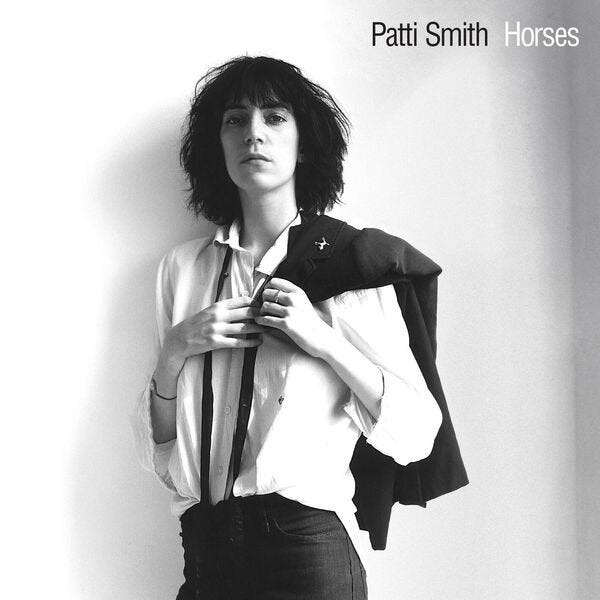
For years now I’ve been thinking I was born in the wrong time. I’ll watch a movie like Once Upon a Time in Hollywood and ache to be in the shotgun seat with Brad Pitt, tooling around Manson-Era LA in his convertible and taking in the sights. I don’t need to be part of a plot, necessarily (and certainly not one written by Quentin Tarantino). But I do want, almost to the point of desperation, to be part of a scene.
On that score, ask me about my ideal retirement, and I’ll tell you I want to spend the last two decades of my life in New York City. Between 1960 and 1980.
Honestly, if you were allotted twenty years to spend in any city throughout all of human history, NYC would have to be the choice. Joining the timeline in the early ’60s, you get the Manhattan of Mad Men and Mrs. Maisel: automats, delis, and skyscraper openings uptown, and down in the Village the grit and broil and first germs of a counterculture, with Lenny Bruce and Pete Seeger and soon enough, Bob Dylan. For sure you would confront the classic ethical dilemma of whether to muck around and stop bad things from happening—here, by sounding the alarm about Bill Cosby. But there’s no time and place in the Anthropocene Era that a well-informed back-traveler couldn’t improve upon.
Get through the coffeehouses without tampering (much) with history, and next thing you know you’re running with John Cage and Warhol and the Velvet Underground. After the Stonewall Riots the decade turns over, John and Yoko move to town, and Iggy meets Bowie at Max’s Kansas City. Marty starts making movies, and a city that always had character becomes a character—place as provocateur, the proverbial snake on the tree branch, nudging and prodding and egging its children on to ever darker extremes. Around this time the IRL City stands up the New York Dolls, Suicide, the Not-Ready-for-Prime-Time Players and throws open the doors of CBGB OMFUG to Joey, Johnny, Dee Dee, and Tommy. Now we’re off to the races, with the New Wave carrying us through to the 1980s.
I know I gave myself just the two decades, which seems a reasonable length of time to live from a retirement age of 64. But assuming my investments beat their projections, might be I can dip out on this 21st-century hell three or four years earlier, so that I’m still alive and kicking when MTV launches from Times Square in August 1981. I could even meet Young Martha Quinn.
I get that this plan is imperfect. Putting aside the impossibility of it as a matter of physics, there are my own limitations to consider. I’ve always lamented that retirement is wasted on the old—wouldn’t it make so much more sense to be free of work obligations when you’re still fit, spry, and fleet of foot? And this goes double for time-travel retirement. The key isn’t just to be present in Cafe Wha? in 1963, the Factory in 1967, and CBGB in 1977. You need to be young, too: energetic and unjaded and able to fully absorb the urgency and importance of the cultural moment—therefore to know, not just intellectually as a critic but deep in your soul, that There is no better time and place to be alive than right goddam here right fucking now. Also, you need to be able to hold up in the mosh without breaking a hip.
Right, so even if I could get back to this Golden Age of New York, it wouldn’t belong to me. I would be a stranger and a tourist, grasping as all tourists do for an authentic experience I could never reach, because I was born twenty years too late and am at any rate too risk-averse to dip into the sea of possibilities.
I did get to New York City in 1995. Signed a lease, got a job, quickly mastered the subway system, and taught myself how to walk the avenues without gawking at the tall buildings. In my three years as a resident I never completely shed the sense that I was that stranger and tourist. I remember one morning I was in the office kitchen, assigning all of my brainpower and attention to the project of cutting a bagel precisely in half, so I could load it into the toaster. One of the partners passed through, and watching me work, he made up a fake statistic about the number of Midwesterners who slash open their palms slicing bagels each year.
That many? I asked, wide-eyed.
Be careful, he said, and he left the kitchen chuckling to himself. And I always am.
Later that year a handful of us were having lunch in the conference room. One of my co-workers mentioned Patti Smith. My brain went immediately to work on this name and came up with this [ahem] super-casual way of showing the group I knew something:
Oh, is she still married to John McEnroe?
That’s Patty SMYTH, Ben said. I’m talking about Patti Smith.
He might have added, Goodbye to You (Apple Music, Spotify), but Ben was probably the nicest person ever to come from Queens, and instead he took a minute to explain to me who Patti Smith was. Because seriously: I was 22 years old and I had never heard of her. Not once. And why should I have? She had never posted videos on MTV, like Patty Smyth had. “Because the Night” (Apple Music, Spotify) was a song Natalie Merchant sang live on MTV (Apple Music, Spotify); I might have been aware it was a cover, but of whose original? And as often as I’d heard Michael Stipe sing … SO GODDAM YOUNG! on Life’s Rich Pageant (Apple Music, Spotify), I had no clue where he’d copped that line (Apple Music, Spotify). What is probably most alarming, in retrospect, is I thought I knew all about New York punk: you know, the Ramones, Blondie, Television, Talking Heads—
just not Patti Smith.
A couple years after I embarassed myself in the lunchroom, I heard “Gloria” (Apple Music, Spotify) for the first time, on FM radio. This was on the very day I moved out of New York, late in the summer of 1998. The U-Haul truck I was driving to Boston didn’t have a tape deck, so I couldn’t wire my Discman into the car radio. I had tried playing CDs over my boom box, but I was bumping along on the Cross-Bronx and the tracks kept skipping. As a last resort I turned to terrestrial radio, which I understood had died years prior and had zero to offer me, aside from possibly periodic re-ups of “Brown-Eyed Girl” (Apple Music, Spotify) on a malingering classic rock channel. And that would have sufficed, given the exigencies of the moment. But instead, pulled down from the ether like a bolt from the blue, a woman’s voice sang these lines:
Jesus died for somebody’s sins—but not mine. Melting in a pot of thieves, wild card up my sleeve. Thick—heart of stone. My sins my own: they belong to ME.
ME.
A minute or two passed before I realized this was a cover of Them’s (Their?) “Gloria” (Apple Music, Spotify). Ha. I had tuned into this frequency expecting Van Morrison, but what I got was much more challenging. The singer rejects Christian redemption, choosing instead to brag about the sexual conquest he1 found humping on a parking meter, leaning on a parking meter. The words ME and MINE predominate in the telling, and putting aside the level of introspection needed to consider that to take on someone’s sins is to divest them of their very identity, it’s nevertheless pretty clear a sociopath is holding the mic here. Now I’m a sucker for covers, even more so when they subvert the source material, so I fell for this one straightaway. It was 1998, though, and there was no Shazaming this song. Fortunately it was the last in a half-hour ad-free block, so that the deejay came on straight off the fade-out and IDed the track for me:
And of course that was Patti Smith with “Gloria” …
“Of course,” I thought. A New Yorker would know that. And good on that deejay for catching me with one foot out the door on my three-year NYC experience, to make sure I didn’t leave Gotham behind forever without plugging into Patti goddam Smith.
Eventually, after seeing it on a hundred lists of All-Time Best Rock Albums, I would go out and buy Horses on CD. With a barnburner like “Gloria” kicking off the proceedings, Patti was able to overcome my strong bias against LPs predating 1976. Still, on the first few listens, only two new tracks jumped out at me. “Redondo Beach” (Apple Music, Spotify) is a crisp and shimmering excursion into reggae, a perfect pop song and a nod to the laid-back vibes of the West Coast, where even the suicides are jaunty. By contrast, “Land” is the record’s climactic moment, a journey of throbbing builds and jarring transitions, as Patti and her band deliver a rawked-up spoken-word hallucinatory recitation about a stabbing attack and the victim’s later opening of his own throat, now and again breaking into a Bizarro-world cover of “Land of a Thousand Dances.”
Suddenly Johnny gets the feeling he’s surrounded by HORSES, HORSES, HORSES HORSES, coming in in all directions, white shining silver studs with their nose in flames, he saw HORSES, HORSES, HORSES, HORSES—do you know how to pony like Bony Maroney? Do you know how to twist?
I’m not ordinarily up for blood-and-guts poetry, and “Land” is likely the but-for prototype of a million tritely Gothic high school literary magazine submissions, whether or not any of their teen authors knew the name of Patti Smith.2 Still, though: put a beat under it, add Lenny Kaye’s crackling guitars, and call now and again upon the knife-wielding protagonist to do the Watusi, and I’ll be at least open to the concept.
He got pen knives and jack knives and switchblades preferred. SWITCHBLADES PREFERRED.
And when, after nine minutes of Patti’s recitation, Johnny is bleeding out in his bed, and he looks out into the blackness and sees this sweet young thing humping on the parking meter, leaning on the parking meter—well, the genius of the Horses project is fully realized.
It was around the time I first cracked open Horses that I first learned, after an inexcusable delay, that the Patti Smith Group was the fifth canonical Downtown punk rock band. That surprising datum got me online quickly looking for contemporaneous and corroborating live video. Back then3 I was able to find footage from the April 1976 Saturday Night Live appearance, where Patti dropped that Jesus died for somebody’s sins bomb on a national audience, called out to her gang at CBGB, and blew the doors off of Studio 8H, up to the point where drummer Jay Dee Daugherty’s cup overflowed and he dumped his kit.
Watching this not only floored me—it filled in an essential part of the picture and changed what I understood about, well, everything to do with rock ‘n’ roll.
I don’t know why my early readings into the mid-1970s New York punk scene had left out Patti Smith. This could just have been bad luck. A writer for Rolling Stone or Spin overwrites their word count, Patti’s name hit the cutting-room floor, and I read the resulting article. Multiply that accident five, ten times over, and I form a deficient understanding of rock history, through no fault of my own or anybody else. But another possibility is that I was once again a casualty of my entry into the timeline. Maybe these 1990s rock journalists had certain biases, and though they knew just what to say about the other seminal NYC punk bands, PSG didn’t fit into their narrative.
To be fair, each of these acts had its own distinctive angle: Television with its two virtuoso/ minimalist lead guitars, Blondie taking girl-group pop to light speed, Talking Heads with their herky-jerk RISD funk, the Ramones being, well, the Ramones. But the Patti Smith Group was a different kind of different, an unaccountable blend of Joni Mitchell, Beat poetry, and 19th-century French bohemianism. There is a hell of a lot going on in “Birdland” (Apple Music, Spotify), for example, and none of it is punk rock. Which is fine, and to be expected: the genre was undefined in 1975, there were no constraints to enforce, and Patti was never one for rules and regulations, anyway. By 1988, when she was turning out schmaltzy protest anthems like “People Have the Power” (sigh: Apple Music, Spotify), it would have been easy enough for the punk fundamentalists on my reading list to write her out of their historiographies. Or at least to sell her short.
When Garth Risk Hallberg’s City on Fire (Amazon) came out in 2016, I reacted as any failed writer does when a peer/ not-peer’s first novel grabs the imagination of book critics: I went into a snit. What kind of a middle name is Risk? I asked no one in particular. Then I quietly added the title to my inbound Christmas list. The story was set in and around New York’s Downtown punk scene and the ’76 blackout. How could I pass on the chance to immerse myself in that time, in that scene? As it turned out, there wasn’t much of Blondie or the Ramones in this story, but one of the central characters was a teenage girl obsessed with Patti Smith.
And what right-thinking Gotham girl wouldn’t have been? Deborah Harry was stunning, sure, but Patti Smith was feral. Savage and ragged, taking zero prisoners, with a voice like a razor blade. By the time she and her band played SNL, they were regulars at CBGB, having played a joint two-month residency with Television (Tom Verlaine was a friend) in the previous year. Imagine going to the Bowery night after night to see Patti and her band develop, refine, and master songs like “Gloria,” “Land,” and “Free Money” (Apple Music, Spotify) live. All this underscoring yet again that I was most certainly born in the wrong time.
My second-best, my consolation prize was to see Patti Smith and two thirds of her original backing band play the entirety of Horses at the Orpheum, here in Boston on Monday night. The record turned 50 this year. Patti is 78 now and can still bring the heat. Same passion and intensity I hear on live recordings from the ’70s, and I especially loved watching her spit on the floor between verses. Hell yeah, I thought. Punk rock forever. Patti Smith and Lenny Kaye and Jay Dee Daugherty reassembled, in person, to perform one of the best records ever made, and they nailed it! But for all her efforts, and as terrific as this show was, the moment—the urgent and essential moment of insurgency, when all this was new and had the culture by the throat—was 50 years gone. And try as it might, the Orpheum’s rundown peeled-paint vibe couldn’t bring it back.
This sense of not-really loss but deprivation, or distance, was exacerbated two days later. We drove down to New York Tuesday night for the Thanksgiving holiday, and on Wednesday afternoon I looked in on 315 Bowery, where CBGB OMFUG used to be, until it closed in 2006. Patti played the last-ever show there; she took the stage at 9:30 PM and didn’t vacate until after 1 in the morning. Now there’s a John Varvatos outlet at that location. They’ve made gestures at honoring the historic venue, most notably by leaving intact a wall with plastered rock posters on it from the old days. In practice, though, it’s just another dickish fashion store. The security guard stopped me shooting video in the shop; just take still shots, he said. When I did exactly that, a sales clerk ran over yelling at me for violating the privacy of other shoppers, then tried to sell me a T-shirt as I beelined toward the door.
John Varvatos—whoever the hell he is—doesn’t own the CBGB logo or legacy. I can get a shirt at Newbury Comics for a third of the price. And what’s more important, if I put Horses on the platter and turn off the lights, I can see about taking myself Downtown, where all the color is swirled away and our clothes fade to black, where the walls are plastered with torn bills selling subversion and catharsis, in a room streaked with cigarette smoke where they promise country, bluegrass, and blues but deliver jagged three-chord modernity dashed with poetry and lookback artifice, where Rimbaud and Johnny do the Watusi while the latter bleeds out from the neck. We bump and thrash and sweat and scream until the lights go out and we run outside gasping for air, looking for sweet young things with their legs wrapped around street signs.
It ain’t time-travel, but until someone I know builds a functioning flux capacitor, it will be the best I can do.
The Internet is divided on the question—is Patti singing as woman or man in this song? I’m hearing a man, based on the admittedly sexist assumption that it take a y-chromosome to talk this level of trash.
When I was reading this crap as an editor of the Howland Scribe, they certainly didn’t.
Lately NBC is on the warpath to copy-strike any intact and complete performances of SNL’s musical guests posted to YouTube. If you want the full monty, you’ll need to subscribe to Peacock.
So fun reading your stuff again. But more importantly, how many of my poems did you nix at the Scribe?
The album cover always threw me. For some reason, it just screams slow-jazz vibes to me. But then when you finally hear it -- it's the polar opposite.