Brian Eno, 1/1

On Wednesday afternoon I took the Red Line train downtown for my yearly physical. I was eight months overdue for this one. My doctor’s office is on Washington Street east of Downtown Crossing. Years and years ago, when I first signed on with my PCP, I worked a half-mile’s walk away. Now I live in Belmont and work in Cambridge, it’s not especially convenient to have my doctor located in Boston, and for a while I put off scheduling this visit, because I had it in mind to change to a provider closer to home. Finally I bit the bullet and put an appointment in my calendar. I caught a break in that Wednesday was a beautiful sunny day, with the temp peaking just above freezing. Give me a day this cold in November and I’d be cursing the heavens. But mid-week in February, after the blizzard conditions Sunday and Monday? 37 degrees and sunshine are a balm for the soul.
During the course of the examination I remembered why I like my doctor so much. I’m not sure he knows me. I’m not a regular in this office [knock wood], but he reads my chart off the computer and meets me afresh each time I come in. This time he noted where I work and in what capacity. The miserable intersection of my gig with current events piqued his interest, so we kicked that subject around a little. He urged me to get a shingles shot at CVS. On the topic of Varicella zoster, I mentioned that back in 2013 I had come into his office with blisters down from my crown to my shins, and he’d brought his colleagues into the exam room to consider the medical curiosity of adult-onset, second-time chickenpox. See “Once and Never Again.” My doctor made a face. He had no recollection of this. It’ll be in the chart, I told him. And that’s as much news as you’re going to get here about my physical examination.
Well, I suppose I can also say I went down the hall to have my blood drawn. From there I was sent through the locked door back into Reception. The clerk affirmed I had no co-pay obligation—thanks, Obama—and with that I took my leave of MGH Downtown. Earbuds in, thumbing through Apple Music on my phone to figure out what I was going to listen to on my walk back to the train station. Eno, I said to myself. Yeah, let’s do that. I’ve been playing a lot of Brian Eno’s solo material this week, largely because on Monday I started outlining the next-next episode of our Krautrock podcast (Apple Podcasts, Spotify), which will cover Eno’s collaborations with Cluster and Harmonia in the mid-/ late seventies.
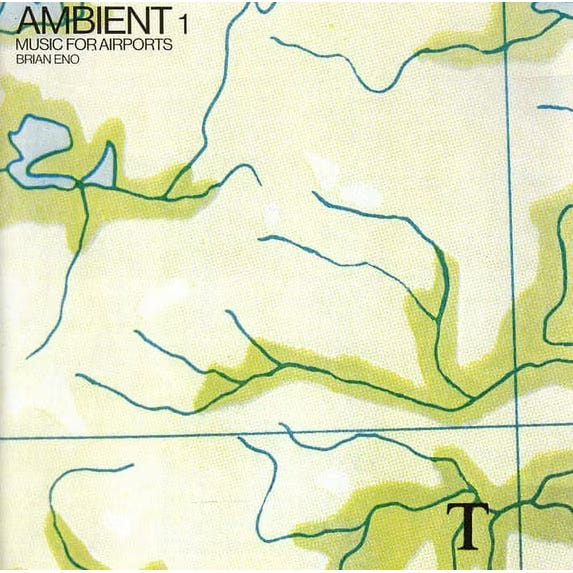
Because I’ve never given it a meaningful listen, I settled on Ambient 1: Music for Airports. While I was cuing it up, the elevator door opened and closed. I got quickly to the button and called it back before it could get away. The opening tones of “1/1” (Apple Music, Spotify) folded around me as I rode down to ground level.
My earbuds have three settings: “Immersive,” “Quiet” and “Aware.” I’m not sure what the difference is between Immersive and Quiet. They both activate the noise-canceling tech and seem interchangeable. Aware works like old-school headphones, admitting some measure of ambient (ahem) noise. When I fired up this Eno record on Wednesday afternoon, I happened to be set to Aware, so that I could receive the needed auditory cues—[rush of doors opening], ping!, [doors now closing]—to send me after the elevator. (Contrast all the Immersive and Quiet stretches I spend down the hall from my office, missing one elevator car after another while I read texts or work the Pips puzzle on my phone.)
Aware is never my first choice—as I’ve previously noted, a principal and enduring objective (compulsion?) in my life is to achieve maximum abstraction from my environment through portable music players. See “Feels So Good.” The thing is, when I was out shoveling the driveway Monday night, the falling snow soaked through my knit winter hat, causing the wet polyester to trigger the earbud sensors tucked underneath. More than once this started my earbuds cycling endlessly through the three audio settings, which in turn set off Lady Bose shouting the changes into my ear—
Immersive! Quiet! Aware! Immersive! Quiet! Aware! Immersive! Quiet! Aware! Immersive! Quiet! Aware! Immersive! Quiet!—
until I could get my gloves off, my phone out of pocket, and my hat peeled up off my ears to make it stop. This round-and-round operated like an audio-only slot machine, and when the spinning finally stopped, I must have landed on Aware. I wasn’t aware I was set to Aware, but that’s the setting Destiny chose for me on Wednesday. Turns out this was a real stroke of luck, and here’s why.
With a backing soundtrack of “1/1” I started my walk up Washington Street. The immediate plan was to pick up a Diet Coke at McDonald’s, then ease on up to the Park Street T station. As I rolled back the Earth under my feet, my Aware setting allowed brief washes of sound to pass over me, over, under, between, and around the gentle piano and bass music not-quite-filling my ears. Order number 1636, said the woman at the counter. Can I see your slip? Two men talking on the way into a shop: Gotta drop your dollars, amirite? Yeah, gotta drop my hundy. Two college-aged girls behind me: I was like, I dunno. [pause] It was frustrating. EDM playing outside the food court on the corner of Washington and Winter. Church bells sounded the clock landing on 3 PM.
All these intrusions on my solitude, and ordinarily I’d have begrudged every one of them. But in the moment—I expect I’ll use that phrase, in the moment, quite a bit in this post—I was grateful to receive them. Each one flashed briefly and fit beautifully within the frame of Eno’s musical arrangement, before slipping away. This routine walk became non-routine, because unlike any of 17,000+ tracks I might have dialed up in my iPhone’s library—or for that matter any of the tens of millions in Apple Music’s—“1/1” was not going to cooperate with my longstanding program of abstraction. It had determined instead that I should spend the next seventeen minutes, twenty-one seconds in the moment.
My ears were already open, so next I opened my eyes, to examine the world around me. Not just to allow it to pass forgettably through my field of vision, while I composed a reply on a text thread or scripted in my head what I might say in my next meeting, but really to look at everyone and everything. To take it all in, process it, and value it.
I considered the street signs, the storefronts, the cabana-sized all-weather flower stand in the middle of the pedestrian roadway just past Winter Street, the luminescent bowed figures arranged on steps to nowhere, which I understand now is part of a series of art installations in the City’s “Winteractive” program (named for the season, not the street)—and which, now that I look at them, are apt enough representations of all of us as we move through the physical world at the direction of the Invisible Hand (see “My City Was Gone”), our Outlook calendars, and so many other unseen forces we don’t consider or recognize.
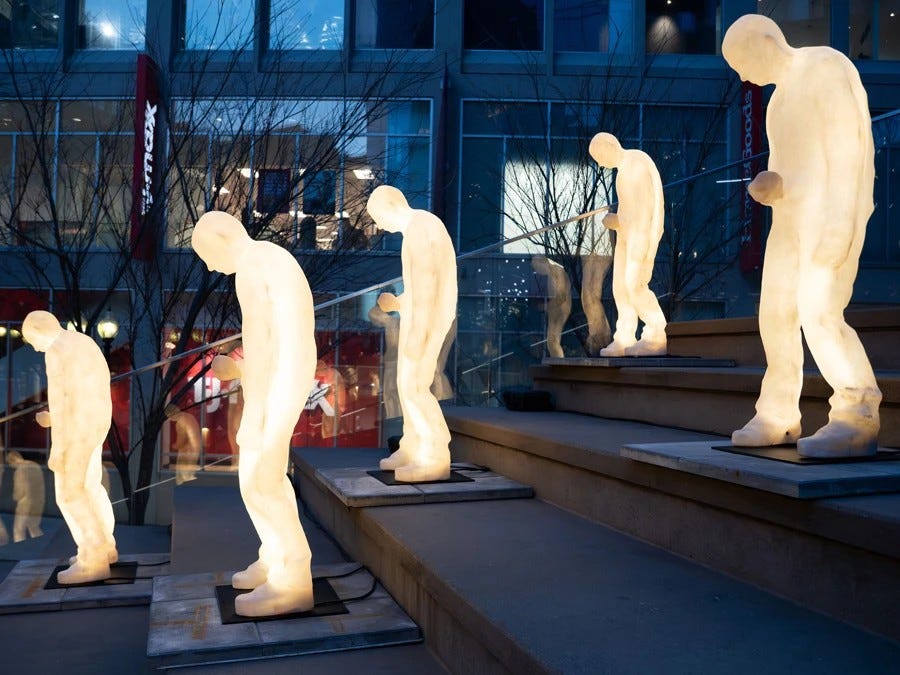
The sights are always there; you only have to accept the invitation to see them. This sounds straightforward, but it really isn’t. As I walked, I thought about a passage in The Phantom Tollbooth—one of many such passages that continues to stick with me, forty years after I last read this most important book in my life. In this particular one, Milo is told the story of the City of Reality, whose residents realized they could get to their destinations more quickly if they looked only at their shoes. As time passed and the community’s notice of its surroundings diminished to zero, the entirety of the city’s infrastructure faded into invisibility. Nothing quite so literal or dramatic has happened to Boston, but as I walked up Winter Street toward the park on Wednesday, I considered that I might have broken a spell I myself had been under, so that I might see, if only for the afternoon, what was never beneath my notice but too often behind it.
But that bit from The Phantom Tollbooth had to do with buildings and streets. Let’s talk about the attention I was suddenly able to give to all—no, not all: each of the people I saw while in transit. This one stopped on the sidewalk checking her phone, that one pulled up short at the corner in a wheelchair, this middle-aged woman huddled in a doorway with her head in her hands, that young man showing friends the new shoes he just bought. People in Bruins gear, surgical masks, Canada Goose parkas, security guard unis, day-glo work vests. Something about “1/1,” or so I believe, drew these people out. Or, rather, drew me out. The music sparked in me an uncanny interest in and warmth toward every last person whose life’s business carried them into my line of sight.
My default is to credit Brian Eno for this. But I could be wrong. Who’s to say what exactly steers the mind in a particular direction at a given moment in time? An unfathomably vast multiplicity of factors drive human psychology. Environmental suggestions certainly must count for something, but there are genetic/ evolutionary and physiological inputs, too. It just so happens I have a test result showing that my blood sugar was on the high end of the normal range just before I stepped out into the street Wednesday afternoon. Would a hangrier version of me listening to “1/1” have felt the same wash of love and warmth? It seems unlikely.
The suggestive power of “1/1” was surely enhanced by what I had earlier read and heard about Eno’s Music for Airports record. His aim was to develop a substitute for Muzak—a kind of music that was gentle and inobtrusive but did not put the listener’s subconscious immediately to work tuning it out. “1/1” locates itself in the liminal space between background and foreground. It absolutely makes a claim on your RAM, but only a small one—tapping into just enough of your consciousness to execute a very particular function, which is to burnish and shine up your immediate environment, so that everything and everyone you experience displays its own distinctive grace. I don’t know if Music for Airports works exactly as Eno intended it. I can only describe how it worked on me, in a moment of absolute serendipity after creeping up on me (if not my earbuds) unawares.
Of course, no moment can be perfect, and this one was no exception. Early on in my walk there came a point where the following thoughts occurred to me, one hot on the heels of the other:
Hey—wow—you’re really going through something here.
You’re going to want to remember this.
Hell, this could be your Substack post for this week.
You should be taking notes.
Now of course this is the sidetrack my mind would uncover, in a moment of transcendence. It’s the predictable result of four decades’ hard work deflecting boredom, of careful planning and consideration of all contingencies toward avoiding a situation where I’m abandoned and alone without meaningful intellectual stimulus for more than a minute. My mind is so trained to resist being in the moment that it was perfectly natural I would open up an internal dialogue where half of me was rapt, actually and possibly transformatively going through something, and the other half was fixated on logging as much of it as he could for later regurgitation in a blog post.
It’s like I was trapped in a poetic bind Wordsworth couldn’t have anticipated, because he never could have predicted a hinky brain like mine, toggling urgently back and forth between the conflicting imperatives of
<gotta fully experience this crazy-pants overflow of emotion>
and
<gotta take mental notes so I can recollect the hell out of this in my later tranquility>.1
I spent a good minute or two crediting both sides of this argument and getting increasingly irritated with myself. Ultimately I fought my way through to a compromise, whereby I would reinsert myself into the moment fully and completely (or as much as my hamstrung psyche would allow), until such time as I had arrived at the train platform, when I would open up a draft post and start splattering it with notes. By this time I had gained the top of Winter Street, just across from Boston Common. “1/1” was still playing—I think I noted it’s more than seventeen minutes long—and I decided to give myself more time with the song and its effects.
I walked past the entrance to the T station, took a few steps down the diagonal path into the park, then decided to double back into the Ladder District. There was so much more life on the city streets than in the park, and at this point I realized I was on the clock, that there would come a point where this visitation would be completed, the world around me would lose the glow of grace that Brian Eno’s music and my brain chemistry had impressed upon it, and I would be back dropped in front of a computer screen, puzzling through regulations and cursing out the government. I wanted to take in everything I could before that magic was gone.
It occurred to me that if all or even some critical mass of humanity—say, 20% of us—put on Music for Airports, set our headphones to Aware (if applicable), and walked out in the world, maybe we’d all suddenly gain the capacity to love each other. To put aside our prejudices and snap judgments, stop wondering if that passer-by voted for Your Gal or Their Guy, and recognize one another’s common humanity. World Peace Through Eno, I was thinking. Now four days later, on the far side of the start of Our Next War, it all sounds pretty quaint and naïve. But in the moment, as I considered texting the Apple Music link for “1/1” to my entire contact list, I started crying.
A few minutes later, “1/1” abruptly cut out of my earbuds. My phone was ringing. Goddammit. It was my friend and work colleague, Ellen. Talk about intrusions upon my solitude: in recent years Ellen has been nothing short of a force on this front. Kate and I are settled on the couch, fire in the fireplace, streaming Netflix on a Sunday night … the phone rings. Is that Ellen? Kate asks. Yep. Driving down Sandy Pond Road on a crystalline weekday morning, vetting a recent edit of a podcast episode … the phone rings. Ellen, it’s not even 9 AM. And so on. But for all that, I almost always take Ellen’s calls. She’s one of the all-time greats, and she recently retired from the office. I really do miss her.
But again: I was in the moment and going through something. Not this time, Ellen, I said, barely aloud, ducking past a college student coming up the snow-narrowed sidewalk in the other direction. I turned left off West Street, back onto Washington, registered and valued a dozen more pedestrians—some new, some I had seen before on this walk—then turned back up Winter to the train station.
As I waited on the platform for the outbound train back to Harvard, I pulled out the phone and Face IDed into my messages. I knew that doing so would put the lights out on this experience. The halo would go away, severing the sense of connection—no: more than that—integration with my environment, the City of Boston, and each of the lovely people I had encountered on my extended walk from 294 Washington. But it was easier than I thought to rejoin the “waking” world, because I understood that I can replicate this experience simply by resetting the conditions for it. I can do this in Harvard Square, Belmont Center, Progressive Field, or better yet: Logan Airport, where I am so often tired, defeated, and miserable.2 All I need to do is toggle my settings to Aware and dial up “1/1.”
Of course it won’t be the same if I try to make it happen, I thought. But honestly, even a half-approximation of the present-ness I felt back on Washington, Winter, Tremont, and West Street would be worth the time. And having logicked my way through to that consolation, I re-engaged with my phone. Ellen had left a message:
Hey I’m going to Smith Center. I’m gonna be sitting somewhere near Pavement. Come visit.
She of course thought I was upstairs in my office. The train arrived and I must have boarded it, but I remember nothing of the transit between Park Street and Harvard stations, as I had surrendered to my abstraction impulse and was vigorously thumbing out my notes of this experience and outlining this post. Upon arrival I disembarked, rode the escalator up to surface level, took two wrong turns (Where’s Pavement? Oh, right: she said Smith Center), then a right one, and I found Ellen seated in my building’s lobby, talking on the phone. She waved a greeting to me, and when she finished her call, I swooped down and gave her a hug.
It was the hug I wanted—still—to give everybody in the world.
For more on these concepts, see “Maggot Brain.”
I suppose this is why Eno titled the album as he did: he knew airports were where we needed him most.
When the city pleasantly invades ..