The Sugarcubes, "Birthday"

By now we all know about Björk. She’s nearly forty years (some would say fifty) into her career. And although from one album to the next she continues to surprise us with her range and reinvention, we know what she stands for. Even if don’t know what exactly is coming next, we have an idea. And we know that voice.
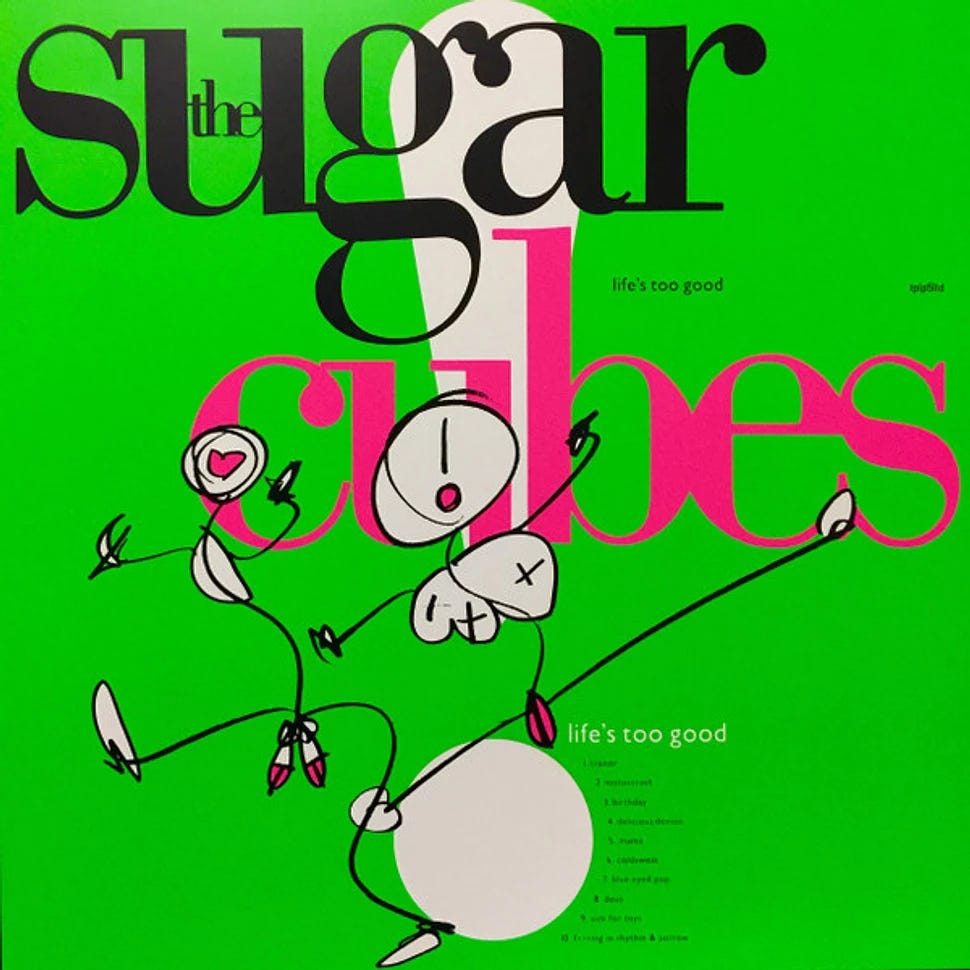
So it is that as often as I play the Sugarcubes’ debut album, Life’s Too Good, I feel a sense of loss, because I didn’t give this band a chance until long—long—after the Sugarcubes broke up. Life’s Too Good was released in 1988, the Sugarcubes managed three U.S. tours in the ensuing years, and because I was clueless, I missed them each time. The closest I got was in July 1989, when they played at Blossom near Cleveland, with New Order and Public Image Limited. I was desperate to go, but only to see New Order, and I couldn’t swing it in any case.1
In my defense, I was fifteen. Not so very enterprising in my taste for music. If it wasn’t synth pop, I wasn't especially interested. And to be sure, I also missed the Beatles at Shea, Ziggy-era Bowie, and all of Punk Rock When It Meant Something. But in this case I was so close, and I blew it.
But what wrenches me most when I listen to Life’s Too Good isn’t that I never saw this band live. It’s that by the time I first heard this album, it was long since baked into the culture cake and familiar to me. So now when I play it, I can only guess at what it must have been like, in 1988, in the state of the culture that existed at that time, to hear this writhing, alien, beautiful madness—for the first time—and I can’t ever know.
See “Panis et Circenses,” on neverstalgia.
Nevertheless, I try. I imagine the ideal condition: brain scrubbed entirely of any knowledge of the Sugarcubes or Björk, body thrust back in time to 1988, when Cocktail was crushing it in theaters and Whitney and Whitesnake were America’s darlings, yet as Master of Space and Time I’ve placed myself in Iceland, atop Eyjafjallajökull while the sun rises, wearing 21st-century Bose noise-canceling headphones.
And I press Play.
Track 1: “Traitor” (Apple Music, Spotify).
A man is talking about playing the harmonica. Straining to hear what’s being said, I turn up the volume. The man stops talking, a brief harmonica riff follows, and then drums land, hard. In the foreground of the mix, a thickly-accented second man announces:
My punctuality is well-known. When the revolution takes place, I’ll be late, and I’ll be shot as a traitor.
At a later date I’ll give this more thought, and I’ll decide that it serves both as a declaration of intent from the band and an apology on its behalf. They have finally arrived, ten years too late for punk, and on the downslope of the Rokk í Reykjavík scene—spun off from it, in fact, out of step with both the culture and the counterculture.
In the background, through a mist of guitars, a woman’s voice reaches into the mix to give stage directions:
EXT. ICELANDIC COUNTRYSIDE
SUN RISES.
The man’s name is Einar. He continues his recitation: When the sun rises, I will not see. I regret nothing.
Drum fills follow. They are gratuitous and excessive, random, tribal, and syncopated. From time to time the woman’s voice moves into the foreground. She makes nonverbal calls, only to be beaten back by the drums. A guitar scratches at the corner of the mix, three notes played over and again, untiring. The aforementioned harmonica makes a brief appearance and is summarily dismissed, in favor of a handful of overlapping vocal tracks. The same woman announcing—willing?—the rising of the sun.
Einar again: My heartbeat keeps time with the drums.
With these drums? I wonder. What would that do to a body?
I smile, just knowing, then the sun rises ... The musicians land on one last chord. Einar allows it to ring out, and into the silence he says—sadly? defiantly?—I will not see.
Track 2: “Motorcrash” (Apple Music, Spotify).
Comes next a jaunty number, rockabilly-ish, but with new wave guitars and synthesized trumpet bleats to propel it along. It’s about a car crash. More precisely, it’s about the perverse pleasure the singer—the woman this time, who I am given to understand is named Björk Gudmundsdóttir—takes in relating the details of the car crash. If this was not apparent from her own breathless retelling, along comes Einar to narrate:
That girl on the bicycle showed great interest in the motorcrashes in the neighborhood.
Yes, fine. I can see that. Wait: you said motorcrashes, plural? There’s more than one? But never mind that: we were talking about the girl, and Einar is pressing ahead. She looked quite innocent, he says. Well, what's that supposed to mean?
Was she involved?
There is more here than meets the eye. Can we slow things down a little? I want to stop, to look, to see what’s happened, but drums and guitar carry me forward into the third verse, which inverts the formula of the last track: now it’s Björk’s vocals—again nonverbal—in the foreground, with Einar providing barely audible commentary. Then suddenly, abruptly, the song decelerates and clangs—crashes?—to a halt.
Well, that was fun. What’s next?
Track 3: “Birthday” (Apple Music, Spotify).
I lie back against the rock face and listen. The sun is climbing in the sky. This one kicks off with more syncopated drums, bass, and smears of muted horns. The words that occur to me are lovely and scene-setting. Pleasant, but with a promise embedded.
First verse. I can’t follow. It’s about a girl, it seems. Fierce, imaginative, arbitrary. Pippi Longstocking comes to mind, or Scout, from To Kill a Mockingbird. She has, I don’t know—projects: spiders in her pockets, and she traps horseflies?
And then suddenly we’ve arrived at a chorus, which is sublime. There are no words. I mean, there are no words sung here that I can transcribe, and I have no words to describe it. It is beautiful and broken and powerful. It breaks the sky to pieces and riddles the air with static shock. I have never heard a voice like this one. It is too perfect to be human, and too human for me to survive. Somehow the volcano under me manages not to erupt, and I feel I’ve caught a break. But then, maybe, it knows it could never compete.
It occurs to me: to this point, they were holding her back. Backing vocals on the first track. Front and center on the second track, but in a straight-ahead pop song. And now, this full blast of alien power. My God.
Third verse: no obvious meaning here—just evocation. Musical impressionism:
She’s painting huge spoons, and glues them together. They so degrade them. It glided down the sky. She trusted.
The chorus lands again, and in this moment I decide that I want to be hearing this song while I’m dying.
Denouement follows. From Björk: dum, dum, dum, dum-de-dum dum dum dum. It makes perfect sense. The Birthday Girl has shattered every bone in my face, she’s now skipping off down the mountainside, and I am smiling.
For the sake of brevity, we can stop the track-by-track real-time reax transcription here. The seven songs that follow “Birthday” are also terrific—all of a piece with these first three. Standouts include the red-hot “Delicious Demon” (Apple Music, Spotify), the vampiric “Coldsweat” (Apple Music, Spotify: This is hot meat, this is metallic blood. I’ll sail out the window, I’ll walk down the hedge, I will not finish ’til I’m fully satisfied), and the Reykjabilly banger, “F**king in Rhythm & Sorrow” (Apple Music, Spotify) that closes out the record.
The genius of the Sugarcubes is apparent up and down the record, but the genius of Life’s Too Good in particular is its slow-rolled reveal of Björk on Side A. From back-of-the-mix to blowing-the-doors-off in ten minutes, it’s the perfect introduction to—yeah, I’m gonna say it—the best and most important singer of these past forty years.
I wasn’t kidding when I wrote earlier that I want “Birthday” playing when I’m dying. I don’t think about this a ton, because Death and I aren’t a good combination—I mean psychologically, I don’t want That Dude in my head. But when I consider that at some later date I might be old and debilitated, limited in my life activities, and winding down toward the Last Stop, I hope that there will be just enough of me left to lie still in the sunshine, attended by friends and family, listening to music. I have a running In Case of Emergency … Break Glass Playlist in my head. The songs aren’t necessarily my all-time favorites, though they’re not necessarily not my favorites, either. What qualifies a song to land on this running list is that it hits me in a very particular way: it says something about the beauty there is in this world, which isn’t always squarely in view.
I expect there will be a lot of Neu! on this Playlist, if/ once I ever actually make it. “I Am the Resurrection” (Apple Music, Spotify) by the Stone Roses, for sure, and Caetano Veloso and Gal Costa’s “Baby” (Apple Music, Spotify) and of course “Dreaming” (Apple Music, Spotify) and I think “Bang!” by the Raveonettes (Apple Music, Spotify) and definitely some Spiritualized (“Medication” (Apple Music, Spotify) seems like a good bet) and probably Sigur Rós.
This is a work in progress, much like the life I intend to live up to and through the point where I need it. Certain songs pass through my headphones or play over a PA, and I make a mental note to add them to this Break Glass Playlist, which for some reason or another I keep failing to open on a computer and start loading. Might be I’m not ready at this point to tempt fate. Problem is I don’t do the best job keeping these notes in my head, so a lot of these songs come and go from memory.
But I can commit to this much at least: first on that Playlist, and maybe again at the end, for good measure, will be “Birthday.”
On this point, I remember staying up late at a friend’s house on a Sunday over Christmas break. We were determined to get a look at 120 Minutes, which in every other week was denied to us. See “Lazarus” for more details. But on that particular night, instead of the usual two-hour stack of alt-rock videos we never otherwise got to see by day, 120 Minutes chucked the second hour to serve up the “special treat” of a live Sugarcubes set instead. We felt cheated. We were angry, and in that moment we—wrongly, stupidly—closed our hearts and minds to the Sugarcubes.