Gal Costa, "Baby"

Writing is hard—until it isn’t. My writing mind is a bit like a self-propelled lawn mower. The pull-start is tricky, and to get it started, you really need to give it a jerk. If you know me, you’re probably thinking: You’re exactly that kind of jerk. So what’s the problem?
Ha, yeah: that’s fair. But now imagine you’ve left the mower in the garage for nine months. It’s covered in dust, the fuel lines are clogged with a stagnant gas-oil mix, and you’ll be lucky to coax even a single electron out of that rusted spark plug. If by some miracle you get the engine started, there’s still the matter of your overgrown lawn, three-feet high and gone to seed. It will be a next-level struggle to impose any kind of order on it.
Just the other day I got it in my head to get back into The Chair and resume the regular practice of posting here. I was up the road charging my car at the time. Sitting, staring at the Space-Age dashboard in front of me, I cast about for any inspiration. None came, and I was frustrated, fully incapable of summoning the state of mind that had enabled me to draft and publish the 100+ preceding posts in this Substack. That work seemed miles away, long gone over the horizon, and the worst of it was that I had let it go. Over two years I’d formed a habit—a good habit—of writing. And for sure, part of what had carried me through that period was a well-founded fear that if at any point I skipped even a single week, I would lose all my discipline. Not necessarily never to find it again, but it would take work: three, four, five, forty-six pulls of that Lawn-Boy handle before the engine caught.
And lately I don’t have that kind of energy.
Around this time a friend of mine sent me a text: The Cameron Crowe talk/book reading was so terrific last night. Please keep writing. I was half-grateful for that and half-feeling like she was taunting me, even if by accident. I was tempted to write back: Funny you should say so, because I was just failing at this. Whatever pearls of wisdom Cameron Crowe uttered I hadn’t heard, and inspiration isn’t something you necessarily receive secondhand. But in any case the last sentence of this inbound text was one more kick in the ass, and a kick in the ass from someone other than yourself is always worth having. This is a simple matter of physics: kick your own ass and it’s at best a glancing blow, delivered from an awkward angle. Whereas a friend can really square you up.
So at this point I was at least motivated to write again. And I had stirrings: brain cells rubbing against one another. Nothing sparking, though. If I was going to summon the daring and energy to break free of my compositional inertia, I was going to need to find my own inspiration.
Enter Gal Costa.
Actually, never mind the stage instruction. Gal was always there at center stage, microphone in hand, waiting for me to lift the curtain. Let me clarify. For at least the last nine months, as far back as when I last left off writing, I’ve had Gal’s recording of “Baby” (Apple Music, Spotify) in the heaviest of rotations. The song is, in all respects and for all intents and purposes, perfect. And as often as I have played it lately—and as much as this late-phase version of me is driven at all times never to spend too long in one place, when I could be out again combing the landscape for lost treasures I could experience as new (see “Your Time Will Come”)—the Costa/ Veloso arrangement of “Baby” never gets old. I can be trundling down Marrett Street to Bedford for my morning caffeine, lying in bed with the light out drifting to sleep, or anywhere in the long stretch of day in between, and this notion will pass into my head:
It’s been a minute: why don’t you put “Baby” on?
Which of course I do, and in the ensuing three minutes, thirty-three seconds I can forget about the world and be, as they say, happy as a clam.
I’ve been thinking a lot lately about breaking patterns. It seems to me important, or at least a pathway to an enriched life experience. For example: Put down the Fromager D’Affinois (see “Mr. Blue”) and try a different kind of cheese. Or Yes: you can go to the movies on a Tuesday. If it weren’t allowed, they wouldn’t be open. These are of course low-level adjustments; I’m fifty-two years old, after all, and not the kind of thrill-seeker you would find parkouring between fourteen-story buildings. And this post, at least so far, is about breaking the lousy pattern wherein I think about writing again, imagine the Iteration of Me that was previously in the good pattern of drafting a post a week, find That Guy utterly unrelatable, and drop the question—usually in favor of dialing up early Ultravox! live performances on YouTube.1
But returning again and again to Gal Costa and “Baby” at any point in time where I might otherwise be alone with my thoughts? That’s a pattern to keep intact and always in your back pocket.
You’ll have noted I mentioned “the Costa/ Veloso arrangement of ‘Baby’” earlier. This is because Os Mutantes covered this song not long after Caetano Veloso wrote it and Caetano and Gal recorded it. The two recordings of “Baby” were splashed across three records in 1968: Gal’s on Gal Costa, My Beloved Mutants’ on their own self-titled LP, then Gal’s again on Veloso and Gilberto Gil’s hugely important compilation record, Tropicália ou Panis et Circences. I have all three of these records on vinyl, but the first time I heard “Baby,” Os Mutantes were playing it.
I have nothing bad to say about the Mutant Baby (Apple Music, Spotify). Its bluesy treatment of the source material, replete with fuzz guitars and whimpering organ, the licentious slurp Arnaldo delivers one line into the second verse, the off-kilter marching militia excursion in the song’s second half—all of this is masterfully done and I don’t question a single note or drum stroke. My only complaint is that I heard this version before Costa/ Veloso, with the result that I was never able to experience the full deconstructive force of it, the My God what have they done?!? shock that would shortly give way to the gleeful abandon we properly feel when rock music reminds us, yet again, that nothing is sacred and in a just and functioning world no prisoners are taken … ever.
Because “Baby” as Gal Costa and Caetano Veloso arranged, performed, and recorded it is positively celestial. It’s what I think should be playing over the PA just outside Heaven’s gates, if I should be sent in that direction after I die and find a backup at the point of entry. Or at least I’d better have some noise-cancelers on me and cellular service, so I can play it for myself.
Somewhat on this subject, I wrote a while ago that I want to be listening to “Birthday” by the Sugarcubes while I’m dying. The truth is I actually have a whole list of songs I hope to be playing in the room if at The End I’m lucky enough to be laid out on a deathbed with the stereo on. I haven’t yet dragged and dropped any of these songs into a playlist—that would seem to tempt fate—but I have a jumble of titles in my head in addition to “Birthday”: a handful of Neu! tracks, Spiritualized’s “Lay Back in the Sun” (Apple Music, Spotify), “Here’s Where the Story Ends” (oh yes: that’s a good one—Apple Music, Spotify), of course “I Am the Resurrection” by the Stone Roses (Apple Music, Spotify). I’m on the fence about the Lips’ “Do You Realize??” (Apple Music, Spotify), but for now, yeah: include it.
The Costa/ Veloso “Baby” will without question feature on my As I Lay Dying Playlist, and by “feature” I mean that I intend to sprinkle it in multiple times, so that I’m never more than twenty minutes without it. As I said before, it never gets old, and I’m strongly of the belief that when you’re on the cusp of leaving this life, Things That Don’t Get Old should take precedence in your consciousness.
But let’s dig in here: why am I so obsessed with this recording? What is so precisely right, gorgeous, and powerful about it? Well, it starts right from the jump, with its simple and humble opening bars: a five-note bass loop, wrapped around a single wood-block stroke. Soon a syncopated guitar and muted drum kit appear in the frame, and shortly after that the studio shot widens to introduce a string section. All the contributions here are humble and restrained, with each musician leaving space not just for each other player, but also for the listener to breathe it all in. For forty seconds this goes on, and it’s almost all that I need.
But then Gal Costa steps to the mic, and I wonder how I lived without her. For those forty seconds, sure, but also for the first fifty years of my life. As I sit typing this very sentence, Gal is singing the first verse—
Você … precisa saber da piscina
da margarina
da Carolina
da gasolina
—and I have tears welling up in my eyes. Here in this nondescript hotel room in Downtown Columbus, on a partly cloudy Friday morning in November. I can only imagine the effect this song will have on me in the sidewalk queue outside of Paradise. Or for that matter on the inside later that night, when I’ve gone to find Gal singing it live.
As the song proceeds, the string section steps up in the mix, toggling between plucks, trills, and swells, often in direct response to Gal’s vocals. There comes a point where Gal sings the words Você precisa apprende ingles: that is, You need to learn English. I only just now realized—after what? 300 listens?—the significance of this verse, which is that it sets up Gal’s later declaration, in the chorus, in English: Baby—baby! I love you!
That epiphany has the hair standing up on my arms, and here I am on the verge of crying again, just when at the back of the mix, barely audible, so that I only picked this detail up after 150 listens, Caetano steps to the microphone. Singing also in English: Please stay … please stay … please stay. Delicate, muted, and oddly late, arriving just in time for the fade-out.
This is perfection, and all the more so because 90% of it is sung in Portuguese, a language that for me sits in precise equipoise between familiar and alien. Portuguese is of course a Romance language, and at various time over the years I have studied Latin, Spanish, French, and Italian. But spoken (and certainly sung) Portuguese sounds like none of these tongues. Certain words or phrases (Há quanto tempo!) are similar enough that I might make something of them. Yet the vowel sounds, inflections, and rhythms of the language are distinctive enough that the comfort of verbal understanding is withdrawn from me just when I think I have a grip on it. Like Tantalus’s grapes, and that’s as good a reason as any to associate this song with Heaven. The exotic pronunciations thrill me, too, evoking a higher race in the same way spoken (and sung) Elvish does in Lord of the Rings. Set against this instrumentation, it’s not hard to hear Gal’s voice as cherubic2, rendered on a plane we all should strive, past all human endurance, to reach.
There is an advantage in not knowing what the words mean, which is that too often a writer’s lyrics don’t live up to the promise of their accompaniment. I have been in no hurry for Google Translate to apprise me of some mundane message that could drag “Baby” down. This is against my nature, to be sure. Usually I’m very curious, inclined on the regular to look up references on Wikipedia; to chase proper nouns across the Internet so I can know who, what, or where they’re identifying; or to run to the dictionary after I’ve punched an unfamiliar sequence of letters into the NYT Spelling Bee and found that it actually registered as a word. But thus far I have not sought to translate the lyrics for “Baby.”
This is not to say that a fair amount of the meaning hasn’t leaked in around the edges. As I earlier wrote, at least some of the singing is in English, and certain words in Portuguese have cognates in languages I have studied. But beyond this I had effectively walled myself off from the song’s meaning, until just the other day, when while raking leaves in the backyard, I tuned into a BBC podcast about Tropicália (Apple Podcasts, Spotify). About midway through the episode, “Baby” surfaced, and before I could take evasive action, one of the panelists jumped into the fray with his thoughts on the lyrical content:
It seems like an innocent, beautiful love song. Baby, I love you. But there’s something a little bit disturbing about a song that repeats and repeats and repeats, What you need is ….
Or in Portuguese, Você precisa, você precisa, você precisa …
It turns out the singer is actually badgering her love with a list of instructions on How To Stay Hip. I am aware that the Tropicália movement, at its core, was expressing a blissful screw-you-all ambivalence about Brazil’s roiling culture war in the late 1960s, wherein Brazilians on the hard left and reactionary right grappled with the questions of what modern and Western influences—Coca-Cola, the Beatles, etc.—they should embrace, and to what extent. That ambivalence, the simultaneous enthusiasm and discomfort, is perhaps nowhere better expressed than in “Baby.” And for as long as I’d resisted accessing the meaning of these lyrics, it turned out that having it thrust upon me wasn’t the worst result, either. A simple love song would have held the line, provided the sentiments were rendered with some degree of originality. But love + social commentary, delicacy + snark with an undercurrent of menace? Well, that’s positively irresistible for a guy like me.
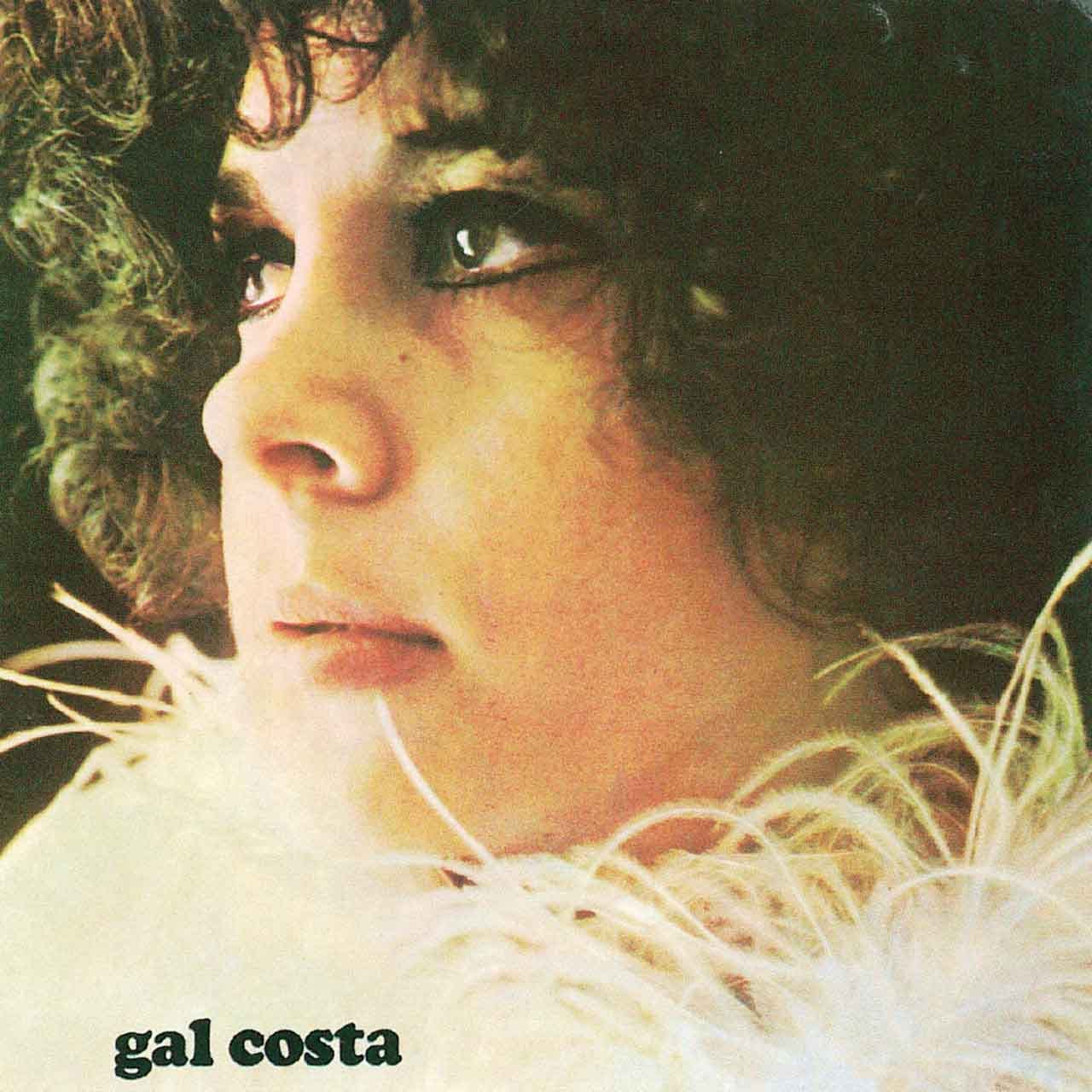
A few weeks ago Kate texted me from the record store in Central Square, to ask if there was anything I was looking for. Anything by Gal Costa, was my answer. Minutes later she sent me a photo of the self-titled record, the very cover you see at the top of this post. Yes! I wrote back, straightaway. Get it get it get it!
This Gal Costa record, my God. It’s an absolute gem. A gleaming artifact of 1960s pop. Gifted session musicians; masterful arrangements with strings, winds, and horns; a singular vocal talent—you see here all the elements of Dusty in Memphis (Apple Music, Spotify). Geez, even the tone and wash of the cover photos are similar, and you have to wonder if Dusty’s record wasn’t the blueprint here. But Gal Costa S/T has the added benefit of local rhythms, and the psychedelia isn’t just seasoning on this record—it’s served up in phat, funky chunks. So much of this meal is delicious:
The chorus of “Sebastiana” (Apple Music, Spotify), where Gal recites her vowels: A! E! I! O! U! Ypsilon!
The driving beat and R&B hooks of “Vou Recomeçar” (Apple Music, Spotify).
The goddam everything of the Roberto Carlos cover, “Se Você Pensa” (Apple Music, Spotify), with its piddling 1.4 million Spotify hits that I’m personally looking to double by the end of the calendar year.
I could go on, but I don’t want to lose sight of the fact that parked way down in the track listing is “Baby.” Just one of the Top Ten Recordings of the 20th Century—yes! I just committed to that—tucked quietly into the latter half of Side B. Unbelievable. Extraordinary. And enough to get me off the mat, back at my desk, and writing these posts again.
Muito obrigago, Caetano e Gal.
In my defense, John Foxx is riveting here …
Note that I didn’t say angelic, because I earlier reserved that likening to Miki Berenyi and Lush, see “Leaves Me Cold.” As time goes by and (hopefully) more of these posts accumulate, I put myself at risk of introducing conflicts, or positing an internally inconsistent aesthetic. Bullet dodged here, but I can’t promise one of them won’t get me smack between the ribs, at some point.
I'm so glad I sent you that text and I'm so glad you wrote this. What a song.
Welcome back! .. but, are we going to have to find “Baby” ourselves?